Wednesday, January 25, 2012

8 Tips for Road Safety in Construction Zones

The Great American Highway is decaying - it's crumbling, a part of the national infrastructure that badly needs a facelift. That said, highway construction zones are popping up everywhere.
Drivers must put up with long delays, lane changes, congestion and ultimately frustration while commuting. And sometimes construction zones are unavoidable, so drivers have to take care, caution and extra time to get to where they're going safely.
Being a safe driver comes with the responsibility to exercise caution, good judgment and put workers first in highway construction zones.
Here are some best practices for entering into and driving through highway construction areas:


  • Give yourself adequate time to get where you're going. Ever notice you hit every red light only when you're late?
  • Check the traffic patterns on TV, radio or internet websites prior to departure. You may even be able to plan a route around heavy traffic or construction areas.
  • Take the time to read the signs. Signs can tell you how fast to go, what lies ahead and when congestion should clear up. they'll also tell you when you've exited the zone.
  • Use your headlights even in the daytime. Making your vehicle more visible also helps roadside workers.
  • Keep a safe distance. Unexpected stops are prevalant in construction zones and rear-end collisions are commonplace.
  • Obey flaggers.
  • No texting while driving. Talking on a cell phone, tuning the radio, eating, reading, or other similarly distracting activities can quickly lead to an accident.
  • And most of all - SLOW DOWN! Many accidents can be avoided just by going a little slower. This increases your reaction time, and allows workers to more safely maneuver throughout the workzone.
With a little more care and caution, we can lower the risks of injury to roadside workers, and improve our nation's highways for generations to come.

Sunday, January 1, 2012

5 States with the Highest Number of Work Zone Fatalities

The 2010 crash fatalities per state have been published by Work Zone Safety. They report that there were a total of 32,885 total crashes in the 50 states (not including Puerto Rico), with 576 crashes in work zones for the year.

Here are the 5 states with the highest number of crashes in work zones:
  • Texas – 96 work zone fatalities – 2,902 total = 3.3% work zone crash fatalities
  • Georgia - 57 work zone fatalities – 1,187 total = 4.8% work zone crash fatalities
  • Florida - 43 work zone fatalities – 2,398 total = 1.7% work zone crash fatalities
  • California – 41 work zone fatalities – 2,671 total = 1.5% work zone crash fatalities
  • Illinois - 32 work zone fatalities – 895 total = 3.5% work zone crash fatalities
These 5 states represent 251 of the 576 (43.5%) of the total work zone crash fatalities for 2010.

Alaska, Delaware, Hawaii and New Hampshire and North Dakota all reported 0 incidents of work zone related fatalities.

Alaska, the District of Columbia, Rhode Island and Vermont only registered double-digit traffic fatalities not work-zone related.

From 2009 to 2010, there were:
  • About 1,000 fewer overall fatalities overall - 33,883 in 2009 and 32,885 in 2010
  • About 100 fewer work zone fatalities 680 to 576
  • Texas went down from 109 to 96
  • Florida – down from 82 to 43
  • California – down from 46 to 41
  • Georgia – up from 32 to 57
  • Illinois – up from 31 to 32
Wikipedia estimates these states will have the largest total populations in 2011: California, Texas, New York, Florida and Illinois.
HiVis Supply wishes you a safe and happy 2012, where work zone fatalities are zero. There is no reason for work zone fatalities, and we believe they can all be prevented by awareness, discipline, slower driving and hi-visibility clothing and safety gear.


Tuesday, November 29, 2011

3 Ways to Prepare for Winter Drivers - Part 2 - The Pedestrians


In last week's installment, we talked about preparing for winter road conditions as a driver, including maintenance on your vehicle, and mental preparation for a hazardous environment. 

We all know that driving in winter is challenging. But what can you do as a roadside worker, construction worker, flagger, crosswalk guard, bicyclist or pedestrian to keep yourself out of harm's way?

1. Cyclists - Make sure your bike head and seatlights are in working order. These lights must be working properly and cover north, south, east and western exposures, and bright enough to be seen in tough conditions. Get a mirror and reflectors, both are inexpensive and useful. Remember to ride against traffic so you can react to what's happening ahead of you, and most of all, always don hi-visibility gear such as safety vests, signal lights and armbands.

2. Pedestrians - Use sidewalks whenever possible and take off your earphones, or at least lower the volume so you can hear the ambient noise around you. Use crosswalks and wait for signal hands to change before entering the roadway. And, as with cyclists, walk towards oncoming traffic for the ability to make quick self-preservation decisions. If you walk regularly, there are hi-vis t-shirts and mesh safety vests for warmer weather, and fluorescent sweatshirts, even hivis parkas with retro-reflective material and reflective stripes for you die-hards who will walk and workout in the most extreme conditions. 

3. Flaggers, Construction Workers and Roadside Workers - As we've said before, he key to staying safe is staying visible. Hi Vis clothing, hi-vis apparel, high-visibility jackets, pants and accessories are the absolute best way to keep safe during the winter months. Flaggers are your first line of defense if you're a part of of roadside construction crew, but who's going to defend the flaggers? By simply being on the road, you're at the mercy of vehicles, no matter how safe you act or work, but you absolutely must be seen in high visibility clothing and hi vis accessories. And, depending on the speed of the vehicles near or around you, you may need a different class of hi-vis safety vest, or high-vis jacket.

Check out safety vests, Hivis apparel, hi-vis accessories, and traffic safety apparatus at HiVis Supply. The holidays are here, and you need to stay safe while at work or out on the roadways.

Monday, November 21, 2011

6 Ways to Get Ready for Winter Part 1 - The Driver

Getting ready for winter road conditions early is everyone's job. Don't wait until it's too late and you're caught or stuck on the roads and unprepared. This goes for everyone including drivers, pedestrians, cyclists or roadside construction workers - but mostly for responsible drivers.

 Driving in winter is challenging and creates numerous hazards. It's darker, the weather is usually worse, and can be extremely hazardous including freezing rain, icy roads, strong winds, snow, sleet, runoff, and heavy fog, not to mention the extreme brightness snow can cause when the sun is at its peak.

 So what can you do to get prepared early and drive safely in the winter?
  1. Have your car serviced -  including getting all of the fluids changed, and windshield wipers checked. This also includes the battery that will take a beating.
  2. Make sure you don't drive when you can't see - how many times have you pulled out because you're going to be late to work while squinting through an unclear windshield?
  3. Make sure you have the proper accessories - A scraper for your windshield, rear window and side view mirrors for blind spots. And don't forget the jumper cables - long warm ups, use of headlights, and everything on can work to drain a battery.
  4. Slow down - The faster you're going, the longer it takes to slow down, and this principle multiplies in severe weather. 
  5. Keep a safe distance between you and the car in front of you - Make sure there are three seconds between you and the car ahead of you in good driving conditions, and further in bad.
  6. Turn your lights on - Take all the precautions you can to see and be seen on the road, including running your lights in the daytime.


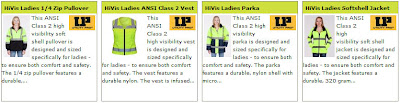
HiVis Supply is a reseller of high visibility garments including several Class II ANSI women's hivis vests and jackets including this Utility Pro® Pullover, safety vest, Parka and Jacket.

Wednesday, October 26, 2011

High-visibility Clothing for Highway Workers Mandatory by Dec. 31


photo by Earl Dotter
On December 16, 2009, The Federal Register Final Rule and revised document of the 2009 Manual on Traffic Control Devices (MUTCD) was released, marking the final phase-in for compliance on all public roads that are not federal-aid highways by Dec. 31, 2011. The regulation for federal-aid highways has been in force since November 2008.

The purpose of the regulation is to decrease the likelihood of worker fatalities or injuries caused by motor vehicles and construction vehicles and equipment while working within the right-of-way on highways whether they’re federally aided or not. The definitions described are as follows:

Workers - people on foot whose duties place them within the right-of-way of a Federal-aid highway, such as highway construction and maintenance forces, survey crews, utility crews, responders to incidents within the highway right-of-way, and law enforcement personnel when directing traffic, investigating crashes, and handling lane closures, obstructed roadways, and disasters within the right-of-way of a Federal- aid highway.

Close proximity - within the highway right-of-way on Federal-aid highways.

High-visibility safety apparel - personal protective safety clothing that is intended to provide conspicuity during both daytime and nighttime usage, and that meets the Performance Class 2 or 3 requirements of the ANSI/ ISEA 107–2004 publication entitled ‘‘American National Standard for High-Visibility Safety Apparel and Headwear.’’ Go to the U.S. National Archives for more information.

The rule for federal aid highways states that “all workers within the right-of-way of a Federal-aid highway who are exposed either to traffic (vehicles using the highway for purposes of travel) or to construction equipment within the work area shall wear high-visibility safety apparel."

HiVis Supply is a reseller of high visibility apparel including ANSI approved clothing, safety vests, traffic vests, hivis vests, ANSI Class 2, ANSI Class 3, ANSI 107-2004, ANSI 207, ANSI Class E, public safety vests. Visit our store for all of your high visibility apparel needs, call or email.

Monday, October 24, 2011

5 tips for Winter Driving Safety

With autumn waning, and winter just around the corner, driving becomes a major factor in road and safety awareness. Keeping your automobile in good working condition over the winter months allows for a higher degree of safety, and staying visible is no flippant task.

Pedestrians, cyclists, motorcyclists and drivers all need to do their part because seeing each other is the first tenant of safety. Hi visibility safety vests should be worn by walkers, cyclists, school crosswalk workers, road-side construction and first responder teams.

Here are some simple precautions drivers can take in reference to maintenance and driving safety:

Get a tune-up – Avoid, to the best of your ability, having roadside issues in the first place. Maintaining a vehicle will lessen the chances of becoming stranded, thereby creating a dangerous situation.

Use your lights – In some countries, they use their headlights at all times, and why not? It’s just a simple habit that you could get into, but especially in the darker, winter months.

Check your tires – Wear and tear on your tires happens in the summer months as well, but remember, tires are your only contact with the road. In the winter, not only rainy but slushy and snowy wintry weather adds to the driving danger.

Have your brakes checked – You may need to stop readily, and having your brakes in tip-top condition is crucial. Luckily, sometimes all you need are pads replaced, and replacement of pads saves the discs. Maintaining your brakes will save you a lot of money over the long haul also.

Maintain a safe distance – This one goes hand in hand with having your brakes checked. When you have good brakes, you know that you can stop when you need to – in perfect conditions. But in wintry weather, conditions are often wet, slippery and icy, causing brake distances to be longer. Stay further back than you regularly would and remember to look ahead of the car you’re immediately behind.

Hi Vis Supply is dedicated to serving the public through safety education but also by providing solutions to keep you safe when visibility is low – whether you’re taking a walk, cleaning a parking lot or repairing America’s road system. Check out these and other products for pedestrian and driver safety.

Tuesday, October 18, 2011

"Texting While Driving Kills."


On Wednesday, May 19, UN Secretary General Ban Ki-moon was joined by US Ambassador to the UN Susan Rice, Russian Ambassador to the UN Vitaly Churkin, US Secretary of Transportation Ray LaHood, and FocusDriven founder and President Jennifer Smith. Together they announced a Global Call to Action on Ending Distracted Driving.
Secretary General Ban Ki-moon urgently insisted “We Must Instill a Culture of Road Safety.”

He then proceeded to give some statistics on car fatalities:
  • 1.2 million people around the world die in car accidents
  • Nearly 50,000,000 injuries
  • 90% are from low or little income countries
Car accidents are now the top global killer of young people ages 15-19 with factors that include:
  • High speeds
  • Drunk driving
  • No seat belt or child restraint used
  • No motorcycle helmet used
The General Secretary stated that, "Use of a mobile phone while driving increases the risk of a crash by 4 times, (while in) some countries 90% of drivers report using mobile phones while driving.
"Culturally," he said, "We must make 'distracted driving unacceptable' by the government and socially unacceptable to the public.
“I want every driver in the world to get the message, ‘Texting while driving kills.’”

The UN initiative will work to promote road safety and while prohibiting nearly 40,000 UN employees from texting while driving UN vehicles. The UN General Assembly has also declared a “Decade of Action for Road Safety,” including a message to all drivers of the world; “Don’t let using a mobile for a few seconds make you and others immobile for life.”

The US Ambassador to the UN Susan Rice continued to say that in the US in 2008, nearly 6,000 people died in distracted driving crashes, but the statistics are hard to come by, since it isn't always readily apparent the reason why the accident took place.

She also said that studies by researchers at the University of Utah show that using a cell phone while driving delays a driver’s reactions as much as having alcohol in your blood up to the legal limit of 0.8%.

Hi Vis Supply concerns itself with all matters pertaining to roadways, particularly with that of roadside construction, and increasingly that of distracted driving, and believe that awareness will lead to prevention in the US and across the globe.