Monday, March 19, 2012

Struck-by Accidents in Construction/Vehicle Back-Over


 The US Department of Labor (DOL) has produced a series of prevention videos regarding safety in industry and on the jobsite. To see the series, go here.

In the U.S., more than 800 construction workers die every year while on the job. Being struck by vehicles, heavy equipment, and other objects is the top cause of injuries and the second cause of death for construction workers, killing more than 150 workers in 2009. But these injuries and deaths can be prevented. 

Employers have a responsibility to provide a safe workplace and required protective equipment. You'll see that taking the right protective steps saves lives. 

All scenes are based on true stories. A surveyor was spray painting the ground to outline the area for a new building pad. At the same time, the driver of a wheel tractor scraper was moving forward to get the ground ready for pad construction. There was no spotter at the site, and there was no internal traffic control plan in place. Before backing up to go over the ground again, the driver checked his rearview and side mirrors. He didn't see anyone in his mirrors, so he  up. The driver's back-up alarm didn't work, so the surveyor did not hear the scraper coming towards her. As the driver backed up, he ran over the surveyor. She died from the injuries.

Let's look at the events leading up to this tragic incident, and see how it could have been prevented. When a vehicle on a construction site has an obstructed view to the rear OSHA's standard requires employers to provide that vehicle with a working back-up alarm, or a spotter on site to tell the driver when it is safe to back up. Now let's see what happens when protective measures are in place. Although there is now a working back-up alarm, it is barely audible over the background noise, so as an added safety measure there is also a spotter on site wearing a reflective vest. There is also an internal traffic control plan in place. This plan helps protect workers because it tells the drivers of moving vehicles and equipment the safest way to move around the work site. So this time, before backing up, the scraper's driver waits for the spotter's signal so he knows the area is clear to enter. Now as the driver reverses, the back-up alarm can be heard and no workers are near the scraper.

This example shows the importance of employers following OSHA's vehicle safety standards for construction sites to ensure that workers are provided with a safe workplace.

These types of construction worker deaths are preventable.

The protection measures shown here save workers' lives. Please follow OSHA's safety standards at worksites: it could be the difference between life and death. If you would like more information, contact OSHA at www.osha.gov or 1-800-321-OSHA.

To view the video or get the transcript, go here.


Professional Surveyors Vest

The Professional Surveyors vest, from ML Kishigo, is designed to exceed the demanding needs of a highly functional surveyors vest. It is constructed with a solid polyester front /Ultra-Cool mesh back; and features a 2" 3M Scotchlite reflective material laminated to 3" contrasting color – increasing daytime visibility. Other features of the vest include: left and right mic holders; zipper front closure; two lapel grommets; reinforced webbing at high stress points; and a plush neck liner for comfort. The pockets of this surveyors vest include: left chest 2-tier pocket with dual function flap that can be held open by Velcro; large right gusseted pocket; outside lower pockets with flaps; left and right stake pockets; left and right elastic spray can pockets; lower inside left and right full length zipper pockets with load bearing straps; and a hidden back pouch with left and right zipper access. Available in high visibility Lime and Orange; sizes M-5XL. Choose from both ANSI/ISEA 107 Class 2 compliant and ANSI/ISEA 107 Class 3 compliant vests.

HiVis Supply is a reseller of high visibility apparel including hivis vests, ANSI Class 2 and ANSI Class 3 for a variety of job duties like construction, shipyard construction, and warehouse and facility maintenance.


Wednesday, February 29, 2012

Street Signs - What you Thought You Knew

Did you know that an "aging population" is taking over the U. S. roadways? Check out these statistics:
  • A person 65 years-old needs 4X the amount of light to see at night compared to a 25 year-old.
  • By 2025, The AAA Foundation for Traffic Safety projects that 1 out of 4 drivers will be 65 or older.
  • The larger the sign, and increased retroreflectivity, allows for quicker decision-making for older drivers and faster response times by emergency personnel,  allowing them to more easily read and understand signs thus reducing travel times to emergency situations.
  • More than 50 percent of traffic accidents resulting in fatalities occur at night. Increased retroreflectivity helps to address this issue.
Street Signs

There are no requirements to replace “perfectly good signs” with new signs because of the mixed case standard. The requirements for mixed case letters in street signs generally apply when signs are replaced because of normal wear and tear. Thus, there is no added cost associated with this requirement.

Many media reports are factually incorrect when they state that signs must be replaced by January 2012. The only requirement for this date is that roadway owners have a sign management plan in place.

In 2000, the MUTCD established recommendations for minimum letter heights on street name signs. The MUTCD recommends 6” initial letter height for roads with speed limits of 40 mph or less with an option of 4” initial letter height for streets with speed limit 25 mph or less. Agencies need to evaluate and decide by January 2012 whether or not to use the recommended letter height or use an engineering study or engineering judgment to decide that a smaller letter height is acceptable.

In 2003, the MUTCD added a recommendation for letter heights of street name signs on multilane roads with speed limits greater than 40 mph. The MUTCD recommends 8” initial letter heights for post mounted and 12” letter height for overhead street name signs. Agencies need to evaluate and decide by December 2018 whether or not to use the recommended letter height or use an engineering study or engineering judgment to decide that a smaller letter height is acceptable.

Brilliant Series Class 2 Heavy Duty Vest


The Brilliant Series vests from ML Kishigo provide maximum visibility with a high visibility background material and 2" wide VizLite reflective tape with contrasting color, making it ANSI/ISEA 107 Class 2 compliant. This vest also utilizes Brilliant Trim reflective edging which considerably improves the vest's low light visibility. The reflective piping improves recognition of the wearer by distinguishing their silhouette from the other stationary objects around them. The vest is constructed of a durable and breathable 100% polyester mesh. Vest features include: zipper closure, mic tabs on chest, 2-tier pencil pocket, flapped radio pocket, inside patch pockets, outside cargo pockets with adjustable flaps, and reinforced webbing for added strength. Available in both high visibility Lime or Orange. Sizes M-5XL.

HiVis Supply is a reseller of high visibility apparel including hivis vests, ANSI Class 2 and ANSI Class 3 for a variety of job duties like mining, surveying, forestry and power generator construction.

Tuesday, February 28, 2012

Minimum Sign Retroreflectivity Timeline


Deadlines were established in 2007 to implement minimum levels of retroreflectivity for signage per the Manual on Uniform Traffic Control Devices (MUTCD).

Maintaining Minimum Retroreflectivity

1. January 22, 2012: By this date, roadway owners must adopt a plan to ensure that their signs meet Minimum Levels of Retroreflectivity by the dates cited below. The FHWA lists 5 options, among which are simple visual inspection and blanket replacement of groups of signs at the end of their “useful life” as stated by the manufacturer.

2. January 22, 2015: Regulatory and Warning Signs and Post-Mounted Signs must meet retroreflectivity requirements.

3. January 22, 2018: Overhead and Street Name signs must meet retroreflectivity requirements. If street name signs meet retroreflectivity requirements and are all CAPITAL letters, they may remain in service for the remainder of their useful life. They never have to be changed out only because of the capital letter/mixed case issue.

FHWA estimated the cost for making these retroreflectivity improvements throughout the entire United States to be $37 million dollars over a 10 year period. The reason that this figure is lower than some estimates reported in the media is that the implementation timetable detailed above was designed to roughly coincide with the useful life of existing signs. Thus, it is likely that most of them would have been replaced anyway.

For more information, check out the Sign Retroreflectivity Toolkit.
Also, check out the FHWA Sign Visibility page.

Fleece Lined Bomber Jacket


The fleece lined bomber jacket from ML Kishigo is ANSI/ISEA Class 3 compliant, and features a durable, waterproof shell with a fleece liner and fleece lined hood. In addition to the high visibility color material, the jacket also utilizes black material in the areas which most commonly get dirty - helping the jacket maintain a bright and clean appearance. The fleece lined hood is both removable and can also be hidden. Also includes, 2" wide 3M Scotchlite reflective material, right chest wallet pocket, left chest radio pocket, zipper slash side pockets and drawstring hood. Available in high visibility Lime and Orange; sizes M-5XL.


HiVis Supply is a reseller of high visibility apparel including ANSI approved clothing, safety vests and traffic vests for a variety of job duties like roadside construction, manufacturing and plant assembly.

Wednesday, January 25, 2012

8 Tips for Road Safety in Construction Zones

The Great American Highway is decaying - it's crumbling, a part of the national infrastructure that badly needs a facelift. That said, highway construction zones are popping up everywhere.
Drivers must put up with long delays, lane changes, congestion and ultimately frustration while commuting. And sometimes construction zones are unavoidable, so drivers have to take care, caution and extra time to get to where they're going safely.
Being a safe driver comes with the responsibility to exercise caution, good judgment and put workers first in highway construction zones.
Here are some best practices for entering into and driving through highway construction areas:


  • Give yourself adequate time to get where you're going. Ever notice you hit every red light only when you're late?
  • Check the traffic patterns on TV, radio or internet websites prior to departure. You may even be able to plan a route around heavy traffic or construction areas.
  • Take the time to read the signs. Signs can tell you how fast to go, what lies ahead and when congestion should clear up. they'll also tell you when you've exited the zone.
  • Use your headlights even in the daytime. Making your vehicle more visible also helps roadside workers.
  • Keep a safe distance. Unexpected stops are prevalant in construction zones and rear-end collisions are commonplace.
  • Obey flaggers.
  • No texting while driving. Talking on a cell phone, tuning the radio, eating, reading, or other similarly distracting activities can quickly lead to an accident.
  • And most of all - SLOW DOWN! Many accidents can be avoided just by going a little slower. This increases your reaction time, and allows workers to more safely maneuver throughout the workzone.
With a little more care and caution, we can lower the risks of injury to roadside workers, and improve our nation's highways for generations to come.

Sunday, January 1, 2012

5 States with the Highest Number of Work Zone Fatalities

The 2010 crash fatalities per state have been published by Work Zone Safety. They report that there were a total of 32,885 total crashes in the 50 states (not including Puerto Rico), with 576 crashes in work zones for the year.

Here are the 5 states with the highest number of crashes in work zones:
  • Texas – 96 work zone fatalities – 2,902 total = 3.3% work zone crash fatalities
  • Georgia - 57 work zone fatalities – 1,187 total = 4.8% work zone crash fatalities
  • Florida - 43 work zone fatalities – 2,398 total = 1.7% work zone crash fatalities
  • California – 41 work zone fatalities – 2,671 total = 1.5% work zone crash fatalities
  • Illinois - 32 work zone fatalities – 895 total = 3.5% work zone crash fatalities
These 5 states represent 251 of the 576 (43.5%) of the total work zone crash fatalities for 2010.

Alaska, Delaware, Hawaii and New Hampshire and North Dakota all reported 0 incidents of work zone related fatalities.

Alaska, the District of Columbia, Rhode Island and Vermont only registered double-digit traffic fatalities not work-zone related.

From 2009 to 2010, there were:
  • About 1,000 fewer overall fatalities overall - 33,883 in 2009 and 32,885 in 2010
  • About 100 fewer work zone fatalities 680 to 576
  • Texas went down from 109 to 96
  • Florida – down from 82 to 43
  • California – down from 46 to 41
  • Georgia – up from 32 to 57
  • Illinois – up from 31 to 32
Wikipedia estimates these states will have the largest total populations in 2011: California, Texas, New York, Florida and Illinois.
HiVis Supply wishes you a safe and happy 2012, where work zone fatalities are zero. There is no reason for work zone fatalities, and we believe they can all be prevented by awareness, discipline, slower driving and hi-visibility clothing and safety gear.


Tuesday, November 29, 2011

3 Ways to Prepare for Winter Drivers - Part 2 - The Pedestrians


In last week's installment, we talked about preparing for winter road conditions as a driver, including maintenance on your vehicle, and mental preparation for a hazardous environment. 

We all know that driving in winter is challenging. But what can you do as a roadside worker, construction worker, flagger, crosswalk guard, bicyclist or pedestrian to keep yourself out of harm's way?

1. Cyclists - Make sure your bike head and seatlights are in working order. These lights must be working properly and cover north, south, east and western exposures, and bright enough to be seen in tough conditions. Get a mirror and reflectors, both are inexpensive and useful. Remember to ride against traffic so you can react to what's happening ahead of you, and most of all, always don hi-visibility gear such as safety vests, signal lights and armbands.

2. Pedestrians - Use sidewalks whenever possible and take off your earphones, or at least lower the volume so you can hear the ambient noise around you. Use crosswalks and wait for signal hands to change before entering the roadway. And, as with cyclists, walk towards oncoming traffic for the ability to make quick self-preservation decisions. If you walk regularly, there are hi-vis t-shirts and mesh safety vests for warmer weather, and fluorescent sweatshirts, even hivis parkas with retro-reflective material and reflective stripes for you die-hards who will walk and workout in the most extreme conditions. 

3. Flaggers, Construction Workers and Roadside Workers - As we've said before, he key to staying safe is staying visible. Hi Vis clothing, hi-vis apparel, high-visibility jackets, pants and accessories are the absolute best way to keep safe during the winter months. Flaggers are your first line of defense if you're a part of of roadside construction crew, but who's going to defend the flaggers? By simply being on the road, you're at the mercy of vehicles, no matter how safe you act or work, but you absolutely must be seen in high visibility clothing and hi vis accessories. And, depending on the speed of the vehicles near or around you, you may need a different class of hi-vis safety vest, or high-vis jacket.

Check out safety vests, Hivis apparel, hi-vis accessories, and traffic safety apparatus at HiVis Supply. The holidays are here, and you need to stay safe while at work or out on the roadways.

Monday, November 21, 2011

6 Ways to Get Ready for Winter Part 1 - The Driver

Getting ready for winter road conditions early is everyone's job. Don't wait until it's too late and you're caught or stuck on the roads and unprepared. This goes for everyone including drivers, pedestrians, cyclists or roadside construction workers - but mostly for responsible drivers.

 Driving in winter is challenging and creates numerous hazards. It's darker, the weather is usually worse, and can be extremely hazardous including freezing rain, icy roads, strong winds, snow, sleet, runoff, and heavy fog, not to mention the extreme brightness snow can cause when the sun is at its peak.

 So what can you do to get prepared early and drive safely in the winter?
  1. Have your car serviced -  including getting all of the fluids changed, and windshield wipers checked. This also includes the battery that will take a beating.
  2. Make sure you don't drive when you can't see - how many times have you pulled out because you're going to be late to work while squinting through an unclear windshield?
  3. Make sure you have the proper accessories - A scraper for your windshield, rear window and side view mirrors for blind spots. And don't forget the jumper cables - long warm ups, use of headlights, and everything on can work to drain a battery.
  4. Slow down - The faster you're going, the longer it takes to slow down, and this principle multiplies in severe weather. 
  5. Keep a safe distance between you and the car in front of you - Make sure there are three seconds between you and the car ahead of you in good driving conditions, and further in bad.
  6. Turn your lights on - Take all the precautions you can to see and be seen on the road, including running your lights in the daytime.


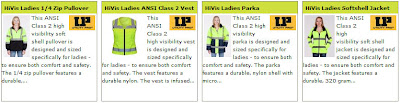
HiVis Supply is a reseller of high visibility garments including several Class II ANSI women's hivis vests and jackets including this Utility Pro® Pullover, safety vest, Parka and Jacket.